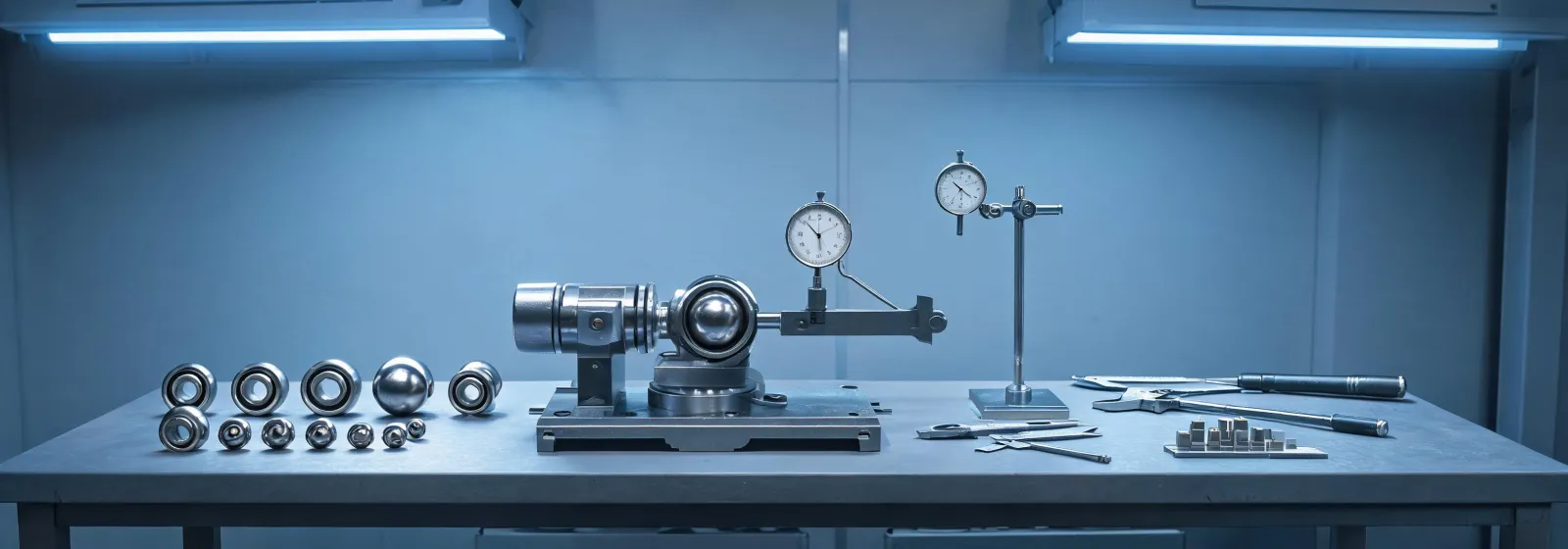
Bearing engineering service bench

Engineering and qualification services

Service flow for bearing programs that cannot rely on catalog guessing

RBC Bearings supports teams that need to move from a difficult load case to a production bearing with evidence for design, quality and sourcing reviews. The work begins with the real boundary conditions: bore size, oscillation angle, speed, temperature, corrosion exposure, lubrication, available envelope and target certification path. From there, engineers compare spherical plain, roller, ball and liner choices against L10 life, radial clearance, torque, wear and inspection expectations.
01

Application review

A spec engineer translates duty cycle, radial load, axial load and misalignment into candidate bearing families. The review keeps aerospace qualification, rail overhaul interval and defense shock load requirements visible before a drawing is released.

02

Prototype and document pack

Prototype lots can be paired with inspection reports, material traceability, dimensional checks and certification references. Teams receive the evidence needed for design review, supplier quality review and sourcing approval.

03

Production handoff

Once the bearing selection is stable, RBC Bearings aligns lead time, packaging, serialization and repeat inspection points so procurement can support recurring builds without re-opening every technical issue.

Process timeline

1

Capture the load case

Share bore, housing material, shaft condition, load direction, speed, motion angle and temperature. The first pass filters designs that cannot survive the duty cycle or certification environment.

2

Match the bearing family

Engineers compare spherical plain, ball, roller and linear motion options against ISO 281 concepts, liner wear, radial play and maintenance access.

3

Validate documentation

Quality teams review AS9100D, Nadcap, ISO 9001 and AAR M1003 references together with traceability expectations, inspection records and production route controls.

4

Release supply plan

RBC Bearings aligns datasheets, CAD references, packaging and replenishment expectations so purchasing can support production without losing engineering context.

Documentation stays tied to the part number.

Every serious program needs more than a bearing line item. RBC Bearings treats revision control, process evidence and application notes as part of the supply conversation, which helps teams reduce requalification surprises after prototype release.

Spec engineer review

Send the envelope before the next design freeze.

Include the target bore, load case, motion angle, speed, expected life, environment and certification needs. A concise first review can prevent oversizing, wrong liner selection or avoidable procurement delays.